Can you believe it's already time to have your flu shot again? It seems like the season arrives earlier and earlier every year! In California we usually begin vaccinating around September 1st and continue through March or April. That could be up to 7 months of 'flu season'!
This year the flu shot contains either 3 or 4 strains of like-viruses. It is recommended that everyone 6 months and older receives the flu shot. There are certain groups that are more susceptible to the flu and they are strongly encouraged to obtain the vaccine. They include: the very young, the very old, and the very sick. More specifically this means children, elderly, and those with chronic health conditions. Additionally, people who take care of these types of people, family members, health care workers, should also be vaccinated.
Reports of the 2016-2017 flu vaccine show the vaccine was about 48% effective in preventing the flu. Is this a good statistic? For the people who were covered, yes! For the people who received the flu shot and still got the flu, no. The flu shot is typically engineered about a year in advance by very smart epidemiologists based on how they believe the virus will mutate or change. Some years, they get it right! Other years, they don't. What does this really mean? It means that these scientists look at how the virus has developed and spread and mutated over the past several years and they anticipate (read: GUESS) how it will look this year. They then engineer the vaccine to cover how they think the vaccine will manifest. For example, in the 2014-2015 season, the flu "drifted" or mutated and the vaccine was not as effective as they had anticipated. This does not happen every year, but it does occur. And, as recently as 2 1/2 years ago.
Our clinic has them in stock and we will start administering them on Tuesday, September 5th. Check with your pharmacy or doctors office about when they will start giving flu shots.
Should you get the flu shot? Talk to your PCP about it and make the best decision for YOU! Remember, the best way to prevent the flu is to stay home if you're sick, wash your hands, use hand sanitizer if you can't wash your hands, cover your cough and sneezes, and drink plenty of water! Avoid the sick people, too!
Wednesday, August 30, 2017

Wednesday, August 16, 2017
Rashes
Oh, dermatology. Derm is one of the most difficult areas of medicine/nursing, in my opinion. Is it red? Does it itch? Has it traveled? Have you? Any new food? New lotion/soap/detergent/shampoo/perfume/deodorant?
I found a cheat sheet a few years back and I refer to it all the time!
When we start assessing rashes, we ask the above questions. Also, does anyone at home have it? Have you tried any treatment at home? These questions help narrow our focus. And, hopefully provide us with only 1,000 possible diagnosis' instead of 1,000,000.
First we evaluate the history; as the questions above describe. Then we investigate location; scalp, face, torso, arms, hands, genitals, legs, feet. Bilateral or unilateral? I had a patient last week who said the rash started on one side and then within a week it would start in the same location but the other side of the body! Finally, we describe the rash. Is it macular (flat)? Papular (raised)? Vesicular (like a vesicle; think chicken pox), or scaled?
For example, hives or urticaria are erythematous (red) papules (raised) lesions. "You have an erythematous popular rash!", or hives. :) Herpetic lesions are typically vesicular; think chicken pox, oral "cold sores", shingles.
The more detail you can provide us, OLD CART (remember?), the better! Not all rashes require a dermatology referral. In fact, where I work, I can consult a local dermatologist if I don't know how to proceed. This not only helps the patient (they don't have to wait for a referral, travel to a new provider), I get to learn more about the conditions I am seeing. It forces me to be more specific with my history taking and physical assessment skills.
I will leave you with the ABCs of dermatology. If you have a rash or lesion (wart or mole) that doesn't resolve/heal, bleeds, itches, or changes, review these ABCs and schedule an appointment with a dermatologist or your PCP for a derm referral.
I found a cheat sheet a few years back and I refer to it all the time!
When we start assessing rashes, we ask the above questions. Also, does anyone at home have it? Have you tried any treatment at home? These questions help narrow our focus. And, hopefully provide us with only 1,000 possible diagnosis' instead of 1,000,000.
First we evaluate the history; as the questions above describe. Then we investigate location; scalp, face, torso, arms, hands, genitals, legs, feet. Bilateral or unilateral? I had a patient last week who said the rash started on one side and then within a week it would start in the same location but the other side of the body! Finally, we describe the rash. Is it macular (flat)? Papular (raised)? Vesicular (like a vesicle; think chicken pox), or scaled?
For example, hives or urticaria are erythematous (red) papules (raised) lesions. "You have an erythematous popular rash!", or hives. :) Herpetic lesions are typically vesicular; think chicken pox, oral "cold sores", shingles.
The more detail you can provide us, OLD CART (remember?), the better! Not all rashes require a dermatology referral. In fact, where I work, I can consult a local dermatologist if I don't know how to proceed. This not only helps the patient (they don't have to wait for a referral, travel to a new provider), I get to learn more about the conditions I am seeing. It forces me to be more specific with my history taking and physical assessment skills.
I will leave you with the ABCs of dermatology. If you have a rash or lesion (wart or mole) that doesn't resolve/heal, bleeds, itches, or changes, review these ABCs and schedule an appointment with a dermatologist or your PCP for a derm referral.
- Assymetry
- If you cut the lesion in half, are both sides equal? No? Go see the derm.
- Border
- Most benign (normal) lesions have a smooth border. If you have a jagged, rough border, go see derm.
- Color
- The lesion should all be one color; multiple shades of tan, brown, black, maybe even green, red, or blue should merit a visit with derm.
- Diameter
- The size of the lesion should be smaller than a pencil eraser. If you notice it is growing, and growing beyond this size, go see derm.
- Elevation/evolving
- Is the lesion raised? Is it changing? Any change in elevation or the above criteria should warn you to go see the specialist.
Wednesday, August 9, 2017
Asthma
Asthma has been around for a long time. And, what I mean by this is that a lot of patients were diagnosed with it as a child and told they would likely outgrow it. A lot of people do outgrow asthma. Over the past 30 years we have learned a lot more about how asthma is triggered and treated. One of the main differences between COPD (chronic obstructive pulmonary disease) and asthma is that asthma is reversible whereas COPD is not.
Asthma affects people of all shapes, sizes, ages, and locations, but most are diagnosed before age 7. Asthma is a disease of inflammation and this typically has a trigger. Exercise, cold air, allergies (dust, pets, mold),and infections are all triggers for an asthma attack or contribute to poor control.
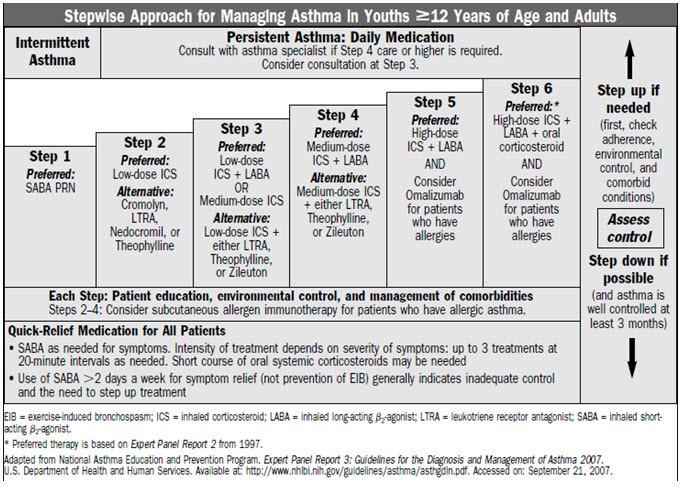
There are 4 stages or classifications of asthma. Mild intermittent, mild persistent, moderate persistent, and severe persistent. Each stage is gauged by how often you experience symptoms and/or need to use rescue medication. This test will help you evaluate how effective your medications are or if you need increased control.
 For example, a patient with mild intermittent asthma has a rescue inhaler they use less than twice a week. They don't wake up at night coughing (classic asthma symptom; dry night-time cough) very often and there is no interference with their normal activities. As long as these standards don't change, the patient is considered to be well controlled. If their frequency of rescue inhaler use increases, their nighttime waking due to coughing increases, or there is interference of normal activities, then they should be evaluated and possibly moved up a step and therefore need a daily asthma controller medication in addition to the as-needed rescue inhaler.
A general rule of thumb is that if you have a diagnosis of severe persistent asthma, you should be seeing a Pulmonologist. Your normal PCP can manage your asthma, but best to consult a specialist if your disease progresses.
There are so many medications to help and treat asthma. The basic ones are a rescue inhaler (short acting Beta agonist; SABA), daily steroid (inhaled corticosteroid; ICS), and a daily inhaler (long acting Beta agonist; LABA). A rescue inhaler is albuterol, typically ProAir or Ventolin. Inhaled corticosteroids are great medications because they reduce inflammation. They include Flovent, Azmacort, Arnuity, and Qvar. The LABA medications include formoterol and salmetorol. The LABA medicines keep your lungs open (bronchodilation) therefore it is really important to take it every single day. If it's raining; you take it. Sunny? You take it. Hot? Cold? Cloudy? Holiday? Out of town? Take this medication every single day. Often the LABA and ICS's are prescribed together making it very easy to get both medications in one dose!
Asthma affects people of all shapes, sizes, ages, and locations, but most are diagnosed before age 7. Asthma is a disease of inflammation and this typically has a trigger. Exercise, cold air, allergies (dust, pets, mold),and infections are all triggers for an asthma attack or contribute to poor control.
There are 4 stages or classifications of asthma. Mild intermittent, mild persistent, moderate persistent, and severe persistent. Each stage is gauged by how often you experience symptoms and/or need to use rescue medication. This test will help you evaluate how effective your medications are or if you need increased control.
 For example, a patient with mild intermittent asthma has a rescue inhaler they use less than twice a week. They don't wake up at night coughing (classic asthma symptom; dry night-time cough) very often and there is no interference with their normal activities. As long as these standards don't change, the patient is considered to be well controlled. If their frequency of rescue inhaler use increases, their nighttime waking due to coughing increases, or there is interference of normal activities, then they should be evaluated and possibly moved up a step and therefore need a daily asthma controller medication in addition to the as-needed rescue inhaler.
 A general rule of thumb is that if you have a diagnosis of severe persistent asthma, you should be seeing a Pulmonologist. Your normal PCP can manage your asthma, but best to consult a specialist if your disease progresses.
There are so many medications to help and treat asthma. The basic ones are a rescue inhaler (short acting Beta agonist; SABA), daily steroid (inhaled corticosteroid; ICS), and a daily inhaler (long acting Beta agonist; LABA). A rescue inhaler is albuterol, typically ProAir or Ventolin. Inhaled corticosteroids are great medications because they reduce inflammation. They include Flovent, Azmacort, Arnuity, and Qvar. The LABA medications include formoterol and salmetorol. The LABA medicines keep your lungs open (bronchodilation) therefore it is really important to take it every single day. If it's raining; you take it. Sunny? You take it. Hot? Cold? Cloudy? Holiday? Out of town? Take this medication every single day. Often the LABA and ICS's are prescribed together making it very easy to get both medications in one dose!
Wednesday, August 2, 2017
Borderline Hypertension
Normal blood pressure is now considered less than 120/80. No longer exactly 120/80. Pre-hypertension is considered as 120-139/80-89. Whoa! That's a change! A lot more people now fall into this category!
 Stage 1 hypertension (HTN) is 140-159/90-99.
Stage 2 HTN is systolic above 160 or diastolic above100.
Typically, medication is initiated when you have had two elevated readings on two different days. Meaning, two readings above 140/90. Some providers may initiate medication sooner than others, but the current recommendations are at 140-150 or 90-99.
Usually we start patients on a medication ending in _pril or a 'water pill', hydrocholorothiazide. There are many medications and just as many reasons leading your PCP to start you on one of the above or another. Please do not say, "Amber said it has to be a _pril medication". Trust them, ask questions, and take your medication as directed!
One common theme I find among patients with HTN is they say they never felt sick. Why should they take their medication if they don't feel sick? HTN, among others, can be called the silent killer. It is usually a gradual increase over time that you don't notice how sick you really are over the past 10 years. Some patients state they can tell when they forget their medications; they get a headache, are more irritable, have a foggy brain. Another reason patients tell me they stopped taking their medications is that they took their blood pressure at home and it was fine so they don't need to keep taking their meds. Um, you're blood pressure is good because you're taking your medication! Keep taking it!
By all means, if you have side effects of new medications, call your PCP. Go tell them what is going on and ask if it could be related to the medication. The worst thing a patient can do is not tell me they're having side effects (or adverse effects) and stop taking the medication. There are so many medications we use to control blood pressure; I'm sure we will be able to find one to help you that won't cause a dry cough.
Like anything else diet and exercise do help reduce blood pressure, but is there anything else you can do? Lose weight, decrease sodium (salt) intake, and minimize alcohol.
One last note about "white coat hypertension", it does exist to a certain point. If I suspect a patient is only having elevated BP during our visits, I will usually retake it before they leave and advise them to buy a home machine or take it at the drug store a few times/week. Finally, if you have a home machine, make sure you know how to use it! Does it go on the wrist? The forearm? The upper arm? This is very important! I had a patient last week tell me her BP had improved and she was going to stop taking her medication. She brought her machine and when I asked her to show me how she used it, it was wrong and therefore gave her a lower reading. When I showed her the correct way, her machine showed a reading similar to what we had; over 160/90. She understood and agreed to stay on her medicine.
 Stage 1 hypertension (HTN) is 140-159/90-99.
Stage 2 HTN is systolic above 160 or diastolic above100.
Typically, medication is initiated when you have had two elevated readings on two different days. Meaning, two readings above 140/90. Some providers may initiate medication sooner than others, but the current recommendations are at 140-150 or 90-99.
Usually we start patients on a medication ending in _pril or a 'water pill', hydrocholorothiazide. There are many medications and just as many reasons leading your PCP to start you on one of the above or another. Please do not say, "Amber said it has to be a _pril medication". Trust them, ask questions, and take your medication as directed!
One common theme I find among patients with HTN is they say they never felt sick. Why should they take their medication if they don't feel sick? HTN, among others, can be called the silent killer. It is usually a gradual increase over time that you don't notice how sick you really are over the past 10 years. Some patients state they can tell when they forget their medications; they get a headache, are more irritable, have a foggy brain. Another reason patients tell me they stopped taking their medications is that they took their blood pressure at home and it was fine so they don't need to keep taking their meds. Um, you're blood pressure is good because you're taking your medication! Keep taking it!
By all means, if you have side effects of new medications, call your PCP. Go tell them what is going on and ask if it could be related to the medication. The worst thing a patient can do is not tell me they're having side effects (or adverse effects) and stop taking the medication. There are so many medications we use to control blood pressure; I'm sure we will be able to find one to help you that won't cause a dry cough.
Like anything else diet and exercise do help reduce blood pressure, but is there anything else you can do? Lose weight, decrease sodium (salt) intake, and minimize alcohol.
One last note about "white coat hypertension", it does exist to a certain point. If I suspect a patient is only having elevated BP during our visits, I will usually retake it before they leave and advise them to buy a home machine or take it at the drug store a few times/week. Finally, if you have a home machine, make sure you know how to use it! Does it go on the wrist? The forearm? The upper arm? This is very important! I had a patient last week tell me her BP had improved and she was going to stop taking her medication. She brought her machine and when I asked her to show me how she used it, it was wrong and therefore gave her a lower reading. When I showed her the correct way, her machine showed a reading similar to what we had; over 160/90. She understood and agreed to stay on her medicine.
Subscribe to:
Comments (Atom)