Friday, December 29, 2017

Healthy New Year Resolutions

At some point or another, most people in my life have made a resolution to lose weight in the New Year; myself included. We all know what happens; by January 15th, we're back to our old habits and those yoga pants and mat haven't been used in a week!

Do you remember the series we did earlier this year about change? In case you need a refresher, start here!

If you want to make some lasting changes in 2018, let's talk about things that we will actually do!

Take a walk. Take a bike ride. Take a yoga or pilates class. Join a gym (and go!). Get a physical. Go to the dentist. Go to the eye doctor. Get a mammogram and pap smear. Check your blood pressure at the pharmacy. Buy a blood pressure cuff. Go to the pool. Take a hike. Go to the beach. Play Frisbee. Buy a thermometer. Dance. Go take Zumba. Review your medications with your PCP. Bounce on a trampoline. Ride a horse. Go to the zoo. Color or draw. Journal. Meditate. Volunteer.

What changes are you willing to make in 2018?

HAPPY NEW YEAR!

Friday, December 22, 2017

At-home medical tools

See the source image

Do you have a first aid kit? Band-aids? A blood pressure cuff? Have you ever thought about what tools you should have at home? Let's discuss!

If you wanted to go above the basic first aid kit, these are the items (and reasons) I would recommend!

1. Thermometer
In my experience, most people don't have one and it's such an easy, simple, crucial tool! When you think you have a fever, take your temp! The information you can give us ("103.4* yesterday"), is valuable. Also, if your kids complain of feeling hot or you feel them hot, check their temp! It is good information to give us when you visit. It can help us in our decision making!

2. Blood pressure cuff
Something similar to this one are all you need! It may not be 100% accurate, but it will get you in the ball park. If you feel dizzy, short of breath, or usually tired, take your blood pressure. Keep track of it throughout the day and even at the same time every day. It, too, can also help us in our decision making process. And, we're able to tell if you really do have White Coat Syndrome! :) Make sure you read the instructions! I've had patients using them incorrectly and their blood pressure is quite elevated in reality.

3. Pulse oximeter
This measure the amount of oxygen in your blood. It is fast, easy, and non-invasive! This would be a great tool for people who have asthma, COPD, or other breathing difficulties. This one covers all your needs; it even gives your pulse reading! The information is important if you are having difficulty breathing or catching your breath.

4. Glucometer
I would only buy this if there is a diabetic in the family and your insurance/health plan does not cover one. Most of us don't have blood sugar issues significant enough to merit having a meter. This tool is valuable if you start to have signs of hypoglycemia (low blood sugar); disoriented, sweaty, weak, lethargic, irritable, headache, hungry, pounding pulse. Check the sugar and then treat accordingly; and follow up with your PCP.

The more information you can give your PCP, the more informed decisions they can make about your health! Do you need all of these tools? No. But, if you're interested and can afford them, it certainly helps.

Friday, December 15, 2017

The Medical Assistant

Have you ever wondered what the medical assistant (MA) does? Do you think they just take your weight and blood pressure and sit around the rest of the day? Let me tell you what they do and how hard they work!

Medical assistants do greet you and take your vitals, but they do so much more! They clean the room in between patients, they perform ear lavages when the wax has built up in your ear, they check your urine for pregnancy and infections, they swab your throat for strep, they enter in all of your information including medications, vitals, recent hospital visits, they update your immunizations and make sure you had your mammo or pap completed, they often pick up on things and alert us (me) before I go in so I can address the issue. Just yesterday a patient came in with vague complaints of abdominal pain, bloating, and back pain. Grace asked the patient about urination and the patient admitted  he did have some pain recently. She had him leave urine right away and let me know what the patient said and what she did. Sure enough, the patient did have a urine infection (among other things). It was her knowledge and attention to detail and subtle cues that helped the patient (and me!).

Grace (my MA) remember patients much better than I remember. She reminds me of abnormal labs or to send a medication if I forget. She keeps track of the paperwork patients bring in and need completed. She is my second brain and is invaluable to me. Grace deserves a raise (and an assistant!). She is not only part of the team, she is an integral part of the team. Medical assistants often get treated poorly by patients, but please remember, she is another set of eyes and ears and may pick up on other needs you have that you aren't even aware of!

When the MA asks why you're here today, please tell them! She can get everything ready to go; she can get the urine dipped and the results to me before I even see you! She ensures you (and I) have everything we need to get the most out of our appointment. Her role is crucial and I cannot imagine not having her around.

Friday, December 8, 2017

Vacation

We went on vacation last month and I (finally) got so relaxed, it's taking me awhile to get back into the swing of things!

When you go on vacation do you like to go-go-go or do you just plop down with a book? I like a little of both. I like to go-see-do, but also need quite a bit of pool time.

Do you like to return to places you've already visited or try something new each time? We like to do both, too! We have our favorite places that are familiar and comforting. We don't feel the need to go-go-go so much when we visit these places; Yosemite and Maui, specifically. Because we've been there frequently we have done a lot of the normal activities, so it's fun to see new things and just enjoy the space and time together. With that said, we do like to go to new places and explore! We went to San Diego this year and I'm hoping to get to Lake Tahoe in 2018.

Does vacation drain you or invigorate you? Do you use the time to recharge or run the gauntlet? Where do you like to travel? Do you like to go with your spouse and kids or leave the kids behind?

The change of pace and location can do a lot for your body and mind. I hope you enjoyed some down time in 2017 and are planning something fantastic for 2018!

Wednesday, September 13, 2017

Flu vs. a cold


Flu season is officially upon us! I mentioned the flu shot a few weeks ago. Has anyone had theirs yet?

The patients I work with are typically from Mexico, Central, and South America. There are a few Africans, Asians, and Eastern Europeans in the mix too, but I have a heavy Hispanic population. In my experience, these countries practice medicine differently than we do in the US. I'm not saying we're better, simply that we do things differently. One of the biggest differences is that when my patients are sick for a day or two, they come to me expecting I will give them an antibiotic. This could be standard practice in their home country or it could be due to providers who would rather have a happy and satisfied patient rather than spend a few extra minutes educating them on the proper use of antibiotics.

In a previous post about patient satisfaction, I discuss the proper use of antibiotics. I'll let you go back for a refresher!

So, what is the difference between the flu and a cold? When should you go see your provider? Good questions! This graphic is excellent! I especially like the suggestions on the bottom of when to see your provider. A cold will usually resolve on it's own in 5-7 days. You may have a residual cough, but as long as you're improving every day, you're ok! You do not need to come in to see us! However, you should stay home from work/church/school!

If you have the flu and come in to see us, we may do a nasal swab (slightly uncomfortable q-tip up the nose farther than any finger can reach!) to check for a flu virus. If the swab comes back positive, then your provider may offer you an ANTIVIRAL medication to shorten the duration of the flu. Meaning, without the medication, you may be sick for 7 days, with the medication 4-5 days.

Other than the antiviral medication, symptom management is the same for both; rest, fluids, handwashing, warm showers, steam, vapo-rub, zinc, etc.

Please give your body time to heal and rest. The best piece of advice to keep you and your family cold and flu-free: wash your hands!

Wednesday, September 6, 2017

Foot pain

There are few issues that bring patients into my office quite as quickly as foot pain. Think about it! If you have foot pain, every single step you take is a reminder of the pain. You can't escape it!

Image result for plantar fasciaNot all foot pain is the same, but one of the most common issues I see is Plantar Fasciitis. The plantar fascia is the white band you see in the picture. It inserts into the heel bone, right in the middle, and extends to the base of the toes where it fans out and attaches to each toe. It's pretty cool and crucial to our ability to ambulate! The most common complaint I receive is pain in the foot when getting out of bed or after sitting for a long time. The pain is so intense patients have had to crawl because the pain of weight bearing is simply too much.

The best way to describe it is as a reverse rubber band. Instead of the plantar fascia stretching out, it is actually contracting and causing the pain. The causes are varied; over use due to running, excessive stretching, weak supporting muscles (hamstring, gastrocnemius, soleus, and even the Achilles tendon), improper foot wear, and even leg length discrepancy.

How is it treated? Like most musculoskeletal problems, we treat with RICE (rest, ice, compression, elevation), anti-inflammatory medications (ibuprofen, naproxen, Advil, Aleve), activity modification, change shoes, orthotic inserts, steroid injections, splinting, and stretching. I have heard old wives tales of patients have bilateral plantar fasciitis and attempting to have steroid injections completed. They have one foot injected but the pain of the injection is so intense that they forgo the second injection. I'm not sure the validity of this, but if you have ever suffered from plantar fasciitis, you know the pain is intense without an injection!

In my experience as a provider and as a sufferer, stretching the foot out over a ball or round object has the best benefit. By using a baseball or frozen 16 oz water bottle and rolling it under your foot, it helps to stretch the fascia back out. Does it hurt? Absolutely. But, it's a pain that hurts so good. Anything round with a diameter around 2" will do the best job at stretching. Other exercises include writing out the ABCs with your foot, scrunching up a towel with your toes, picking up marbles with your toes, bending your toes over a ledge or step, stretching out your calf by pushing against a wall and putting one foot behind the other, toe taps, fascia massage, and Achilles tendon and calf stretches. This study found that by just stretching, 83% of patients felt relief! Even using a foam roller for the foot and calf would help.

Like many other issues, it takes time and consistency. If you believe you have plantar fasciitis, I would try the above suggestions for up to 2 weeks. If you don't see any relief, then schedule an appointment with your PCP.

Wednesday, August 30, 2017

Flu shot

Can you believe it's already time to have your flu shot again? It seems like the season arrives earlier and earlier every year! In California we usually begin vaccinating around September 1st and continue through March or April. That could be up to 7 months of 'flu season'!

This year the flu shot contains either 3 or 4 strains of like-viruses. It is recommended that everyone 6 months and older receives the flu shot. There are certain groups that are more susceptible to the flu and they are strongly encouraged to obtain the vaccine. They include: the very young, the very old, and the very sick. More specifically this means children, elderly, and those with chronic health conditions. Additionally, people who take care of these types of people, family members, health care workers, should also be vaccinated.

Reports of the 2016-2017 flu vaccine show the vaccine was about 48% effective in preventing the flu. Is this a good statistic? For the people who were covered, yes! For the people who received the flu shot and still got the flu, no. The flu shot is typically engineered about a year in advance by very smart epidemiologists based on how they believe the virus will mutate or change. Some years, they get it right! Other years, they don't. What does this really mean? It means that these scientists look at how the virus has developed and spread and mutated over the past several years and they anticipate (read: GUESS) how it will look this year. They then engineer the vaccine to cover how they think the vaccine will manifest. For example, in the 2014-2015 season, the flu "drifted" or mutated and the vaccine was not as effective as they had anticipated. This does not happen every year, but it does occur. And, as recently as 2 1/2 years ago.

Our clinic has them in stock and we will start administering them on Tuesday, September 5th. Check with your pharmacy or doctors office about when they will start giving flu shots.

Should you get the flu shot? Talk to your PCP about it and make the best decision for YOU! Remember, the best way to prevent the flu is to stay home if you're sick, wash your hands, use hand sanitizer if you can't wash your hands, cover your cough and sneezes, and drink plenty of water! Avoid the sick people, too!

Wednesday, August 16, 2017

Rashes

Oh, dermatology. Derm is one of the most difficult areas of medicine/nursing, in my opinion. Is it red? Does it itch? Has it traveled? Have you? Any new food? New lotion/soap/detergent/shampoo/perfume/deodorant?

I found a cheat sheet a few years back and I refer to it all the time!

When we start assessing rashes, we ask the above questions. Also, does anyone at home have it? Have you tried any treatment at home? These questions help narrow our focus. And, hopefully provide us with only 1,000 possible diagnosis' instead of 1,000,000.

First we evaluate the history; as the questions above describe. Then we investigate location; scalp, face, torso, arms, hands, genitals, legs, feet. Bilateral or unilateral? I had a patient last week who said the rash started on one side and then within a week it would start in the same location but the other side of the body! Finally, we describe the rash. Is it macular (flat)? Papular (raised)? Vesicular (like a vesicle; think chicken pox), or scaled?

For example, hives or urticaria are erythematous (red) papules (raised) lesions. "You have an erythematous popular rash!", or hives. :) Herpetic lesions are typically vesicular; think chicken pox, oral "cold sores", shingles.

The more detail you can provide us, OLD CART (remember?), the better! Not all rashes require a dermatology referral. In fact, where I work, I can consult a local dermatologist if I don't know how to proceed. This not only helps the patient (they don't have to wait for a referral, travel to a new provider), I get to learn more about the conditions I am seeing. It forces me to be more specific with my history taking and physical assessment skills.

I will leave you with the ABCs of dermatology. If you have a rash or lesion (wart or mole) that doesn't resolve/heal, bleeds, itches, or changes, review these ABCs and schedule an appointment with a dermatologist or your PCP for a derm referral.
  • Assymetry
    • If you cut the lesion in half, are both sides equal? No? Go see the derm.
  • Border
    • Most benign (normal) lesions have a smooth border. If you have a jagged, rough border, go see derm.
  • Color
    • The lesion should all be one color; multiple shades of tan, brown, black, maybe even green, red, or blue should merit a visit with derm.
  • Diameter
    • The size of the lesion should be smaller than a pencil eraser. If you notice it is growing, and growing beyond this size, go see derm.
  • Elevation/evolving
    • Is the lesion raised? Is it changing? Any change in elevation or the above criteria should warn you to go see the specialist.

Wednesday, August 9, 2017

Asthma

Asthma has been around for a long time. And, what I mean by this is that a lot of patients were diagnosed with it as a child and told they would likely outgrow it. A lot of people do outgrow asthma. Over the past 30 years we have learned a lot more about how asthma is triggered and treated. One of the main differences between COPD (chronic obstructive pulmonary disease) and asthma is that asthma is reversible whereas COPD is not.

Asthma affects people of all shapes, sizes, ages, and locations, but most are diagnosed before age 7. Asthma is a disease of inflammation and this typically has a trigger. Exercise, cold air, allergies (dust, pets, mold),and infections are all triggers for an asthma attack or contribute to poor control.

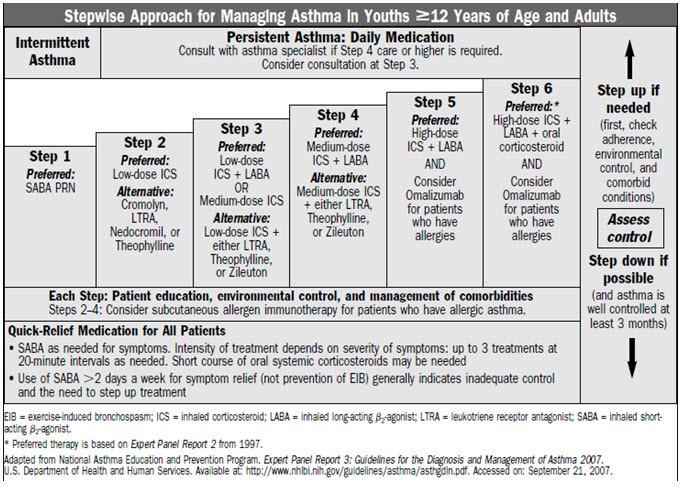
There are 4 stages or classifications of asthma. Mild intermittent, mild persistent, moderate persistent, and severe persistent. Each stage is gauged by how often you experience symptoms and/or need to use rescue medication. This test will help you evaluate how effective your medications are or if you need increased control.

Image result for asthma step therapyFor example, a patient with mild intermittent asthma has a rescue inhaler they use less than twice a week. They don't wake up at night coughing (classic asthma symptom; dry night-time cough) very often and there is no interference with their normal activities. As long as these standards don't change, the patient is considered to be well controlled. If their frequency of rescue inhaler use increases, their nighttime waking due to coughing increases, or there is interference of normal activities, then they should be evaluated and possibly moved up a step and therefore need a daily asthma controller medication in addition to the as-needed rescue inhaler.

A general rule of thumb is that if you have a diagnosis of severe persistent asthma, you should be seeing a Pulmonologist. Your normal PCP can manage your asthma, but best to consult a specialist if your disease progresses.

There are so many medications to help and treat asthma. The basic ones are a rescue inhaler (short acting Beta agonist; SABA), daily steroid (inhaled corticosteroid; ICS), and a daily inhaler (long acting Beta agonist; LABA). A rescue inhaler is albuterol, typically ProAir or Ventolin. Inhaled corticosteroids are great medications because they reduce inflammation. They include Flovent, Azmacort, Arnuity, and Qvar. The LABA medications include formoterol and salmetorol. The LABA medicines keep your lungs open (bronchodilation) therefore it is really important to take it every single day. If it's raining; you take it. Sunny? You take it. Hot? Cold? Cloudy? Holiday? Out of town? Take this medication every single day. Often the LABA and ICS's are prescribed together making it very easy to get both medications in one dose!

Wednesday, August 2, 2017

Borderline Hypertension

Normal blood pressure is now considered less than 120/80. No longer exactly 120/80. Pre-hypertension is considered as 120-139/80-89. Whoa! That's a change! A lot more people now fall into this category!

Stage 1 hypertension (HTN) is 140-159/90-99.
Stage 2 HTN is systolic above 160 or diastolic above100.

Typically, medication is initiated when you have had two elevated readings on two different days. Meaning, two readings above 140/90. Some providers may initiate medication sooner than others, but the current recommendations are at 140-150 or 90-99.

Usually we start patients on a medication ending in _pril or a 'water pill', hydrocholorothiazide. There are many medications and just as many reasons leading your PCP to start you on one of the above or another. Please do not say, "Amber said it has to be a _pril medication". Trust them, ask questions, and take your medication as directed!

One common theme I find among patients with HTN is they say they never felt sick. Why should they take their medication if they don't feel sick? HTN, among others, can be called the silent killer. It is usually a gradual increase over time that you don't notice how sick you really are over the past 10 years. Some patients state they can tell when they forget their medications; they get a headache, are more irritable, have a foggy brain. Another reason patients tell me they stopped taking their medications is that they took their blood pressure at home and it was fine so they don't need to keep taking their meds. Um, you're blood pressure is good because you're taking your medication! Keep taking it!

By all means, if you have side effects of new medications, call your PCP. Go tell them what is going on and ask if it could be related to the medication. The worst thing a patient can do is not tell me they're having side effects (or adverse effects) and stop taking the medication. There are so many medications we use to control blood pressure; I'm sure we will be able to find one to help you that won't cause a dry cough.

Like anything else diet and exercise do help reduce blood pressure, but is there anything else you can do? Lose weight, decrease sodium (salt) intake, and minimize alcohol.

One last note about "white coat hypertension", it does exist to a certain point. If I suspect a patient is only having elevated BP during our visits, I will usually retake it before they leave and advise them to buy a home machine or take it at the drug store a few times/week. Finally, if you have a home machine, make sure you know how to use it! Does it go on the wrist? The forearm? The upper arm? This is very important! I had a patient last week tell me her BP had improved and she was going to stop taking her medication. She brought her machine and when I asked her to show me how she used it, it was wrong and therefore gave her a lower reading. When I showed her the correct way, her machine showed a reading similar to what we had; over 160/90. She understood and agreed to stay on her medicine.


Wednesday, July 26, 2017

Pre-diabetes

Have you been told that you're pre-diabetic? Were you told to change your diet and exercise more frequently? Do you understand what 'pre-diabetic' means? Let's dig in!

Pre-diabetes, hyperglycemia, and high blood sugar are synonymous. A normal, fasting glucose, or blood sugar, for a non-diabetic is usually between 70-110 (results may vary by lab and provider). Do not confuse this test with a hemoglobin A1c, or A1c for short. The A1c is an average of your sugar for the past 3 months. The finger-stick test is what your sugar is right now. A normal A1c for non-diabetics will be below 5.7%.

If your fasting glucose is above 120 and you have an A1c of 5.7%-6.4%, you are pre-diabetic.

If you have two abnormal fasting glucose levels on two different days and an A1c of 6.5% or higher, you are diabetic.

Typically, 2 hours after eating a meal your blood sugar should go back down into the normal range.

If you ate before you had your A1c drawn and the number was high (6.8%), it still means you have diabetes. Again, the A1c is an average of your blood sugar over the past 3 months. One meal before the lab test will not affect this result. It will affect your random blood sugar finger-stick, but not the A1c.

The A1c number increases as your average sugar levels increase.
As the blood sugar number increases, so does the A1c. As a reference, oral medications are usually started first, however, once the A1c reaches 10, insulin is the recommended treatment.

So, now what? What can you do? Take your 'pre-diabetes' diagnosis as a wake up call. Now is the time to change. Now is the time to start the diet and exercise regimen.

Remember a few weeks ago when we discussed fruit, vegetables, meat? This is the new diet. The new norm. Make the changes now so we can delay diabetes as long as possible!

Wednesday, July 19, 2017

Routine Screenings

Have you had your mammogram? What about a prostate exam? A colonoscopy? When do you need these tests? I'm so glad you asked!

The US Preventative Services Task Force has reviewed multiple screenings and decided when and what should be done and how frequently. Let me share the most common with you broken down by gender. This is not exhaustive by any means, but it will be the most common, most basic tests that should be completed routinely. Obviously check with your PCP and see if you need these or any other tests.

WOMEN
  • Pap smears
    • Generally begin at age 21
    • If normal, only need testing every 2-3 years.
  • Breast exams
    • Annually beginning at age 21
  • Mammograms
    • Annually beginning at age 40
      • Earlier if necessary (personal or family history of breast cancer, etc).
  • Colonoscopies
    • Stool test first beginning at age 50
      • If positive, then colonoscopy.
      • If negative, repeat annually.
      • Personal/family hx may change these recommendations.
  • DEXA scan
    • Osteoporosis screening at age 65
MEN
  • Prostate exams
    • Typically with blood work first beginning at age 55
  • Colonoscopies
    • Stool test first beginning at age 50
      • If positive, then colonoscopy.
      • If negative, repeat annually.
      • Personal/family hx may change these recommendations.
EVERYONE
  • Labs should occur based on your personal history.
    • If you have diabetes, every 3-6 months typically.
    • If young/healthy, every 1-2 years.
    • Should include checks for anemia (CBC), liver/kidneys (CMP), cholesterol, HIV, Hep C (if you were born between 1945 and 1965).

Wednesday, July 12, 2017

New NP advice

I'm almost 5 years into my practice and have only recently felt like I'm no longer a novice. This does not mean I am now an expert, not by a long shot, but it means I'm not running to a resource every time a patient comes in with a complaint!

Looking back to the beginning, what would I tell myself? What would I have spent more time on in school? Let me share with you!

1. Spend a lot of time on pathophysiology. The patho, the way the body works specifically in a diseased state, is so important. You can spend an entire lifetime learning about cells, the way they respond during times of disease and stress, the end-organ results, etc. When you then add medications to the disease process, it changes a lot of things-kidneys, liver, other disease processes. The more you continue to work on your pathophysiology, the better off you'll be.

2. Mind your own business. In the age of social media and being 'friends' with everyone it is easy to blur the lines of friends and colleagues. The party from last weekend may have unintended consequences during the work week. If you're friends with one person and not another it can cause unnecessary drama at work.

3. Practice what you preach. People are watching you. Patients, coworkers, administration. There are eyes (and ears) everywhere. Being impeccable with your word, minding your own business, and doing what is required (and expected) of you will go a long way.

4. Keep in touch with your NP classmates. There are 2-3 girls I'm in regular contact with. Whether to ask a question ("If the patient had the BCG vaccine in their original country, do they need treatment when their PPD comes back positive?" (No, order a CXR. Most likely positive from antibodies from BCG vaccine; pt shouldn't have another PPD, thanks Aileen!)), or if you just need to vent, it helps to have someone in the same boat as you.

5. Have a mentor. While I don't have a formal mentor, there are several nurses in my life and one NP friend. I love seeing her at conferences and sharing my experiences with her. She is always available if I have questions regarding nursing, my practice, or my personal life. She has more years experience than my classmates and knows me better than my colleagues.

Are you a new NP? A seasoned veteran? What have you learned about your job over the past several years?

Wednesday, July 5, 2017

Blood donation

Have you ever donated blood? Did you know that if you're 17 and weigh at least 110 lbs, you can donate? It's that simple!

The entire process takes about an hour. When you're done you get to sit and enjoy a snack and some juice or water.

There are several types of donations available but the most common, whole blood, takes a pint of blood. You're eligible to donate a pint of blood every 56 days. Believe me, once you're on the registry, they'll call you! 

There are two other processes; platelet apheresis and plasma apheresis. Both of these are longer, about 2-3 hours, and some of your "blood" is returned back to you! These allow specific blood components to be extracted for donation while the other products of blood are returned back into you via another IV in the other arm.

The most requested blood is O-, the universal donor. Anyone can receive blood from an O- donor. Especially during times of crisis (9-11, hurricanes, earthquakes), blood is needed. One pint of whole blood is just that; one unit and all given to one patient. One unit of plasma or platelets can help multiple people. All are extremely valuable and important.

Besides helping your fellow man, another great component of blood donation is a mini-physical! They check your vitals and keep record. They are able to notice trends in your blood pressure and weight, both of which you may not be aware! Finally, I had one patient bring me lab results from the Red Cross stating they had done extensive blood testing and found a genetic marker for a specific disease. He was following up with me for additional testing. Had he not donated he may never have known he was at increased risk!

What are you waiting for? Go donate today!

Wednesday, June 28, 2017

Swimming!

Now that summer is upon us I feel it's appropriate to discuss water safety and what drowning looks like.

Rarely does it look like what we see in the movies; flailing, splashing, screaming. It's often silent and unnoticed.

Last week we were sitting in a hot tub with our son where he was sitting on the top step with the water barely covering his out-stretched legs. He weighs less than 25 lbs so any movement in the water really sways him and causes him to lose his balance. I was standing right next to him talking to my husband when all of the sudden Martin says, "WHOA! Get him!" In that spilt second, Bub lost his balance and was submerged. I scooped him up immediately but not before he swallowed/inhaled some water. I'm relating this story to show how quickly it can occur and that even though you're right there, you still need to be vigilant.

Water is the one thing I'm most terrified of as a parent. I learned to swim quite late by most standards, but have loved the water ever since. I've been on the swim team, been a lifeguard, taught swim lessons, been scuba diving and snorkeling, but still, I have a very healthy respect for the water.

I have taught private and group lessons, in public pools and in private pools. What's best for your child? Whatever helps them learn to swim! Even with my son, we practice "jumping in" and turning around to swim back to the wall. Can he do this on his own? No. But, we practice it now and keep reinforcing the correct pattern and behaviors. Ideally, you want your child to swim, but they also need to know that if they fall in or are accidentally pushed in, they can turn around and swim to the wall, or flip over to their backs and float. These are the two most important lessons.

The American Red Cross offers classes around the nation. I'm sure your city offers lessons in addition to private swim schools.

And, while the kids are getting their lesson, how about you take a CPR class? See what I did there? Have a great summer!

Wednesday, June 21, 2017

The Plant Paradox

We've all heard the best diet consists of high vegetable, moderate, in-season fruit, moderate protein and fat, right? Well, what if you're following this diet and are still experiencing fatigue, bloating, weight stability or gain, gas, and no movement in your cholesterol, blood pressure, and even sugar levels? This is what Dr. Steven Gundry has set out to investigate.

The Plant Paradox examines the relationship between eating a healthy diet (fruits and vegetables) while still being overweight, hypertensive, and on the path to heart disease. Dr. Steven Gundry has delved into why this diet is ineffective and not helping patients lose weight and reduce risks of chronic diseases (heart disease, diabetes).

Ultimately he reveals the culprit; lectin. Lectins are plants way of protecting themselves against predators; other plants, animals, humans. Inside our bodies, lectins battle with our guts and create a chemical warfare which in turn causes us to hold on to weight and causes a host of other problems.

I haven't read the book, yet. It's on top of my list. It sounds similar to Wheat Belly, in that the food we eat has a direct effect on how we feel.

This is probably the issue I wish patients understood the most. What you eat directly affects how you feel. I repeat: what you eat DIRECTLY affects how you feel. If you eat crap, you will feel like crap. Plain and simple. I usually reserve this for patients who are eating a lot of fast food, highly processed food, etc. There are some people who do eat fruits, vegetables, protein, and fat and do have some adverse effects; gas, bloating, etc. These are simple to explain; each body responds differently. What may be good for one person may not be good for another. Unfortunately, I cannot look at you and determine that you will negatively react to broccoli. This is a trial and error sort of testing.

Another book helpful with testing, reactions, and the inflammatory process is The Plan by Lyn-Genet Recitas. This book is more specific with food testing and the most common foods that most people react to. She is very specific and The Plan is very regimented at the beginning, but it does help identify reactionary foods and how to avoid them.

Have you read any of these? What did you think?

Wednesday, June 14, 2017

The Power of Distraction

This is a topic I've been mulling over for sometime. It sounds great on one hand, but deceptive on the other. Is it therapeutic or a mean placebo? Can the answer be both?

In the time I have been practicing, I have seen the effect of distraction and placebo. While I cannot prescribe a placebo pill, I can encourage behaviors that can distract the patient. Perhaps it is not as overt as the placebo effect, but the results are similar.

You may have seen this pain assessment scale we use in clinics to assess pain.
 
 
I like it because when a patient is popping gum and laughing with me and telling me their pain is 10/10, I have a visual tool to help them reassess their pain a little more accurately. When you get to a 6, I often tell patients this is a pain you can no longer ignore. A pain you can no longer distract yourself from. 10/10 is labor without pain medication, pain so intense you cannot talk, pain that requires immediate medical attention. Saying you have 10/10 when you don't, will not expedite your visit.

Distraction has been proven to reduce patient anxiety during conscious operations. No, they're not doing open heart surgery with you watching Braveheart. These were minimally invasive venous procedures conducted in a private office. The results were clear: patients who were talking to the nurse or watching  movie reported decreased anxiety than patients who were listening to music or had no distractions.

Now, how do we transfer that into our everyday, non-surgical setting? Well, anxiety and panic are two issues I see daily. If a patient were to go for a walk, pet the dog, take their kid to the playground, or throw a few hoops, I venture to guess they would feel a little better. Why? Because like we discussed a few weeks ago, changing your scenery or routine helps to release the physical energy being used to stress.

I work alongside some wonderful Behavior Health colleagues and when I feel the stress creeping in, they often remind me of these very things. Take a walk. Take some deep breaths. Color in a coloring book. Listen to music. Do a relaxation yoga video. Practice guided imagery. Anything you can do to take your mind off of what you're going through is going to help.

Think back to losing a tooth or getting a shot, was distraction involved? "How's your dog? Does he like to go for wal......POP! There goes your tooth!" Distraction. Powerful.

Friday, June 2, 2017

Stayin' Alive

You know the Bee Gees song Stayin' Alive, right? If so, you're already half way to knowing how to perform CPR! Why? Because the beat of the song is the perfect rate for performing compressions during CPR.

Why is CPR performed? Usually because of a heart related issue. It could be a heart attack, or the electrical impulses are not firing correctly, or the heart just stops due to injury or trauma. The purpose of CPR is to compress the heart and pump the blood through the body. Research has shown that pumping the heart is more important and valuable than rescue breathing. There is enough oxygen in the body to keep it moving to the organs while CPR is being performed.

Let me regale you with some statistics to help encourage you to complete a CPR course:

♥ Less than 1/3 of people who collapse outside of the hospital due to sudden cardiac arrest receive CPR from a bystander.

♥ If someone begins effective CPR immediately, the victims chances of survival can double or triples!

♥ People as young as 9 years old can learn, retain, and perform CPR!

♥ The Good Samaritan law will legally protect you while you are performing reasonable, life saving measures.

♥ CPR can be given with rescue breathing (mouth-to-mouth) or without. Compressions alone save lives, too.

 
The life you save may be that of your friends or family. Better to know how to perform CPR and never need to use it than to need it and not know. One note of caution: CPR is physically exhausting; even with a partner and switching off every 3 minutes or so, it is exhausting. You are encouraged to continue CPR until EMS arrives on scene or until you are about to collapse from exhaustion.

Please consider taking a CPR class. Find a buddy and do it together! The classes are usually inexpensive and just a few hours long. It's a small investment for a potential huge pay off.


Friday, May 26, 2017

Sleep

We all know sleep is good for us, right? How good? Really good!

Here's why!

Sleep decreases cholesterol and our risk of heart disease, diabetes, kidney disease, hypertension, and stroke (NIH). This is the reason why we recommend taking your cholesterol medication in the evening near bedtime. It's like a super charge. Your body makes good cholesterol (HDL) while you sleep. When you take your statin (a type of cholesterol medication) in the evening before bed, you are giving your body extra ammunition to make good cholesterol and fight bad cholesterol (LDL).

Sleep regulates hormones affecting our appetites, insulin (think diabetes prevention), and helps with growth and development in children and teens. Our kids deserve all the love and support we can give them, so why not encourage more sleep and consistent bedtimes? I need to take my own advice!

Sleep decreases depression, anxiety, suicide risk and high-risk behaviors. Sleep improves mood, clarity, function, and productivity at work.

Now that I have extolled the praises of sleep, you may be asking, how much sleep do I need? Fair question. The National Institute of Health has the following chart:

AgeRecommended Amount of Sleep
Newborns16–18 hours a day
Preschool-aged children11–12 hours a day
School-aged childrenAt least 10 hours a day
Teens9–10 hours a day
Adults (including the elderly)7–8 hours a day

I recommend closer to 8-9 hours/night for adults. With an occasional Sunday afternoon nap :)

If you're having difficulty initiating or maintaining sleep try to get into a routine. We call it sleep hygiene. Kids have a routine; bath, jammies, books, bed. It helps prepare their minds and bodies for sleep. Adults need that, too. Whether we read in bed for awhile or meditate or have other bedtime rituals, if you get into the habit, you may find yourself feeling more rested in the morning.

Finally, turn off the phone and TV! The electronics keep our brain wired and we have a harder time initiating sleep.

Enjoy the long week and get some extra zzzzzzzzzz's!

Friday, May 12, 2017

Fruit, vegetable, meat (eggs and beans)

This is the phrase I repeat most often at work. You know, if I had a dollar for every time....I could easily be about $11,000 more rich in the past 5 years.

What is lacking from this list? Carbs and dairy! (For the sake of this discussion, 'carbs' include rice, bread, tortillas, cereal, oatmeal, cake, cookies, etc.).

Why?

Sugar.

Sugar is the enemy of health. Cancer feeds off of sugar. Diabetes loves the sugar. Yeast devours sugar. Are you getting the point?

The spiel is, "No tortillas, rice, pasta, potatoes, bread, sweet bread, oatmeal, cereal, cakes, cookies, pies, ice cream, juice".

This diet is applicable to the majority of my patients. Why? Because sugar is the enemy of health. The breakdown of carbohydrates (bread, rice, etc.) is sugar. We have the three main macronutrients; carbs, protein, and fat. When carbs, specifically starches, are ingested they hit us as glucose and we get that "sugar rush". Kevin at Rebooted Body talks about why sugar is such a problem in our diets.

Sugar saturates items we would never imagine. The various names; high fructose corn syrup, corn syrup, maltose, lactose (milk sugar), fructose (fruit sugar), sucrose (table sugar), agave, etc., can be deceptive.

So, when you eliminate carbs, you eliminate a great source of additional sugar in your diet. When I explain this to patients, they always respond with, "I don't eat sugar!", meaning, "I don't ADD sugar to anything". When I press them about their diets; rice, tortillas, and oatmeal top the list of offenders.

By eating fruit, vegetables, and meat, you cut out the most serious offenders and are stocking up (hopefully) on REAL food. Nothing processed or detrimental to your health. Are there exceptions? Obviously. But, if you make better choices every day and choose to have cake for your birthday, your body will be in a much better state. Also, you may start to notice when you eat things that are not conducive to good health, your body tells you. You may experience bloating, GI upset, diarrhea, fatigue, mental fog, and on and on. Your diet is a relatively simple fix to quite a few ailments, you just need to heed your own warning signs.

Friday, May 5, 2017

Know your numbers

know your numbers originalThere has been a recent to push to include patients in their care (what a novel concept!) and part of that is keeping patients informed of their current numbers. These can include blood pressure, A1c (diabetes), blood sugar levels, cholesterol, and BMI.

Most offices now print out a discharge plan for the patient upon the conclusion of their appointment. The information on this paper has some of the information you want; blood pressure, weight and BMI, and possibly lab results. These are useful pages! Keep them! File or scan them and keep a record!


Using your age, smoking status, cholesterol, and blood pressure, we are able to calculate your risk of a heart attack! Depending on your risk level, we will make recommendations regarding diet, exercise, medication management, aspirin therapy, etc. Basically, things you already know you should be doing.


Use this tool to print and take to your next appointment! You will impress your PCP and be well on your way to improving your health!

Wednesday, April 26, 2017

Recommendations

What I am reading or watching? Obviously this list is not exhaustive, but it's a good starting point. I will be linking up new sites/books, as I see fit.
 
Blogs
These are not blogs I read every day, but the former has changed my life. In fact, a lot of principles Kevin addresses have made their way into my practice as well. I am working through his program and continually refining myself, my outlook, and health.

The Nester has a beautiful saying, "It doesn't have to be perfect to be beautiful". Amen. I have applied this to so many areas of life. My home, my appearance, my wardrobe, myself. None of these are perfect, but they are beautiful. My BFF and I often remind each other to be kind to ourselves. We would never tell the other some of the mean things we tell ourselves (you're fat, you're old, you're lazy), so we need to be kind. The Nester helps navigate this, mostly through home décor, but it is applicable to life in general.

Books
Wheat Belly Great information regarding how our body processes wheat, the effects of it in our diets, how the wheat we know today is different from the days of yore, and what you can do to change it!

Choose More Lose More for Life Choose More, Lose More is on the list not for the "diet", but rather the workouts. I LOVE these!! They are hard, fast, intense, and effective! Chris Powell, from Extreme Makeover: Weight-Loss Edition, has developed 28 unique HIIT (high intensity interval training) 9 minute workouts that target upper body, core, lower body, and general cardio. Each day, Monday thru Friday is a different workout. You do not repeat the same sequence of activity for another 28 days! How great is that?! Also, each day the timing is different. You may do one exercise continuously for 3 minutes, or do one rep of exercise 1, then one rep of exercise 2, one rep of exercise 3, and then step ladder upon that. Now, 2 reps of each exercise, then 3, etc for a total of 9 minutes. Another timing workout is you work as hard as you can for 20 seconds, rest for 10, repeat 5 more times for a total of 3 minutes, then do the same with the next exercise. It may sound complicated, but he lays it out very easily. These are the only standard exercises I love to do. I feel strong, toned, and fatigued when I complete the circuit. Also, I love I am able to track how many reps or cycles I completed because when I get back to that same routine in a month, I can see how I've improved. And, for 9 minutes, you can do it! You can do almost anything for 9 minutes! 9 minutes and you're done!

The 5 Love Languages This book is great for learning how you express love and how you like to receive it. Quickly, the five are acts of service, quality time, gifts, physical touch, and words of affirmation. Once you identify how you receive love, you are able to communicate that to your spouse (if they don't already know), and you're able to see ways other loved ones are loving you. I am a quality time and acts of service kind of person. If my husband takes my car to get washed and fills it up....SWOON! I feel like he has taken time out of his day, assessed my needs, taken it upon himself to meet those needs for me. It shows me that he is looking out for me and I feel loved, taken care of, and protected. The rub comes when your loved one doesn't speak the same language. My husband is words of affirmation and physical touch. It has taken me several years to learn the correct words for him and that even if I can't cuddle him right then, I may be able to hold his hand and show him that I'm thinking of him. This book ties in well with the self-care we've been discussing!

Boundaries Another part of self-care is realizing your own limitations and being able to identify areas in your life that may need to be readdressed. Just as children need boundaries to keep them safe, physical and emotional, adults need them in relationships, too. What are you comfortable with in a relationship? You may hear someone say, "Well, this person hurt me and they were late and I'm so mad at them!". Boundaries helps you identify your role in this situation and what you can do to either get more involved or withdraw while helping you form healthy relationships. There may be a person in your life that continually hurts you. Unintentionally, but you continue to be optimistic that this person doesn't mean you harm, will stop hurting you, and will wisen up and learn from this. They may or may not, but YOU can change YOU. You can keep the person a little farther away, emotionally. You can limit your interactions with this person. You are able to determine how often you see them, hear from them, the types of communication you have with them, etc. It is dynamic and empowering. Instead of being hurt and being the victim, what can you do to empower yourself and take control? Excellent read!

Also, just finished Daring Greatly by Brené Brown on Audiobook. Fantastic book! I'm excited to read more her works.
Recipes
Skinny Taste, Low Carb Yum, Eat Real Food.

Movies
Fat sick nearly dead, Food inc, Super size me,

Podcasts
Happier with Gretchen Rubin, The Rebooted Body by Kevin Geary

Disclaimer: Some of the links above are to my Amazon Affiliate page. I am not being paid to recommend any of these products. I found them on my own and believe in them. If you can find help or comfort or education in any of them, then that's great!

Friday, April 14, 2017

Self care as preventative medicine

So, what self-care activities did you do this past week?

Baby boy and I went to the Farmers Market on Saturday and then the park. Having a kid really does help me slow down and actually think about what I'm doing.

Some other ideas of self-care activities include: practicing gratitude, getting 15 minutes of sunshine, walking barefoot in the grass, laying in the grass, relaxation breathing, volunteering, writing a note to a friend, getting a massage, using essential oils, taking a class, teaching a class, journaling, having a pet, stretch, pray or meditate, make a different decision, edit your social media accounts, cook a childhood favorite comfort-food meal, drink tea, ride a bike. Are you getting the idea?

The Wikipedia definition we looked at last week is actually great! The definition continues:

Self-care is considered a primary form of care for patients with chronic conditions who make many day-to-day decisions, or self-manage, their illness. Self-management is critical and self-management education complements traditional patient education in primary care to support patients to live the best possible quality of life with their chronic condition. Self-care is learned, purposeful and continuous. In philosophy, self-care refers to the care and cultivation of self in a comprehensive sense, focusing in particular on the soul and the knowledge of self.
 
Purposeful. Continuous. Knowledge of self. Complements traditional patient education. Self management. These are great buzz terms to encourage and motivate!

Think about it this way: if a patient feels bloated, tired, has heartburn, and suffers from abdominal pain they have a few options. They can come in and see us where they will probably be prescribed a medication to fix the problem. Or, they can try a few things at home. A la, self-care. Food testing by elimination or pairing is taking care of yourself! Treating yourself well by giving your body the right food to work and function well while not harming or causing pain to yourself.

There is a popular book by Gary Chapman called The 5 Love Languages which identifies ways we give and receive love. They are: acts of service, quality time, gifts, physical touch, and words of affirmation. I propose the way we give and receive love is also how we can show love and self-care to ourselves. For example, I am an acts of service and quality time girl. Therefore, when I visited with a friend recently I left feeling recharged and replenished. I could conquer the world! Well, the next week at the very least. If you find words of affirmation are a way to show love, perhaps journaling would be a good way to provide self-care.

Any activity (note: ACTION) you do that feeds your soul (or body) is an act of self-care. With patients in my care, I see a lot of inaction. A patient just this morning was describing ongoing back pain and was unsure why she was having such pain in such a specific location. She wanted to lose weight and exercise more, but she had a response to each suggestion I made to her. She may want to lose weight and exercise more, but her inaction will not get her to her goals. This patient, and most people, are still in the pre-contemplation phase of change. The self-care aspect is action. Being, doing, improving, repeating. Self-care needs to have momentum and intention. Just like above: purposeful, continuous, self-management.

Stay tuned for more on self-care!

Friday, April 7, 2017

Self Care

This week has been rough. Anyone else?

From shocking news to bad news to paying Uncle Sam....TGIF.

I had an appointment on Wednesday that left me unable to work for the day. The choices of what to do were endless!! I had grand ideas of going to Hobby Lobby and buying all the décor my little house needs. A mani/pedi was the perfect way to spend my afternoon! I could lounge and watch Housewives.....UNINTERUPPTED! So, what did I do?

I cleaned my house.

Seriously? Yes. Because there were no little feet plodding behind me wrecking havoc. I was able to focus and get it all done. And then, I crashed. But, I had accomplished a lot and had completed several tasks I had been delaying.

No more energy for a mani/pedi or walk. My attention span wasn't able to cope with an hour of NYCs finest Housewives. We ordered a pizza and called it a night.

But what would have happened if I had gone shopping and had the mani/pedi? My house wouldn't be clean, but my emotional and psychological self would have been restored.

What is self care? Wikipedia defines self care as, "any necessary human regulatory function which is under individual control, deliberate and self-initiated. Some place self-care on a continuum with health care providers at the opposite end to self-care. In modern medicine, preventive medicine aligns most closely with self-care."  Did you catch that last part?! "Preventive medicine aligns most closely with self-care"!! This is what we are doing! This is the essence of The Total Patient.

But, what does this look like? The above definition is a little clinical, IMO. It looks like whatever you need to do to take care of you. Go for a walk, read a book, take a nap, watch a movie, call a friend, organize the nagging junk drawer, go through the mail, clean out the box in the garage that has been calling to you, get a manicure, get a pedicure, read a magazine, watch a show, go to the movies, take a drive, walk on the beach, hike, play cards, listening to your favorite album, scrapbooking, crafting, going to the range, swimming, yoga, pilates, zumba, working out, cooking. Basically, anything that you want to do that you normally don't make time for.

In my experience, completing a task that has been on my to-list for awhile usually helps free up mental energy. For example, cleaning the house also included cleaning up the clutter and making a few trips to the garage for storage and to the dumpster. I changed our winter wreath to the spring wreath and WHAM! It feels like a new place! That, and the Easter egg display I created and baby boy promptly investigated!

When you take time for yourself you are recharging your emotional needs. This helps with improving your outlook. How? I believe it occurs because you are taking the focus off of your normal routine; wake, feed, work, clean, sleep, repeat, and allows creativity, joy, and happiness to flow! Two weeks ago I spent the day with a college friend. What a great day! And, we didn't do anything! We talked, walked, had lunch and dinner, talked, laughed, and just spent time together. I told my husband that my heart was full. I felt ready to take on the new challenges and was refreshed from my time.

Take a break this week to do something for you! Something you don't usually do.

Just like Julia Roberts in Pretty Woman, take care of you!

Monday, March 20, 2017

Laura 2.0

There were very few tears after I got The Call. Unfortunately, I had been mourning her death for a year.

I was so focused on her dying that I forgot she was still alive.

She, obviously, knew she was still alive. Making plans, buying clothes and bags, planning parties. Death took her despite her unwillingness.

The memorial was beautiful; just like her. It was so.weird to have a 'party' about her, without her. Seriously, I kept waiting for her to pop out from the side of the stage or come running down the aisle and leap to the stage.

Her husband is a lawyer and spoke at the memorial. When he started, he explained the only way he was going to get through it was to remain in 'court-mode'. Strong. Detached. Unemotional. Factual. Being a nurse, I often get this way. My husband calls it 'clinical'. I suppose everyone can do this to some extent. Take emotion out of it and do what you have to do. During her illness, I was too clinical. Seeing her as a patient instead of a person. My cousin. She was a patient, but she was not my patient. With my experience in hospice care, I saw the writing on the wall. Even when her doctor told us she had a month, I knew she wouldn't make that. My knowledge and experience was my Achilles heel.

It has been 16 months since her death. It isn't any easier to accept but time has blurred acute pain. Her voice is fading from memory, no more texts or calls, no more Hand and Foot losses.

Why am I telling you about Laura? Because I want to point out some clues that may help you or a friend or loved one.

1. Persistent cough
I am, now, hypersensitive to patients with ongoing coughs. A chest xray is such a simple, and relatively inexpensive test, to reveal a myriad of possible problems. My recommendation is if a cough is not getting any better in one month, ask for a chest xray. Most coughs should improve in 3-4 weeks. If there is no improvement go see your PCP.

2. Vocal changes
This can be attributed to many etiologies, but it needs to be addressed. Cough with vocal changes needs to be assessed. Go see your PCP.

3. Unexplained loss of consciousness
While Laura did not completely pass out, she had two episodes of dizziness, altered state, lack of coordination, flushing, and difficulty concentrating. Again, coupled with her other symptoms, go see your PCP.

4. Difficulty getting comfortable
This was the buzz phrase her husband said that clued me into her final days. Dying patients often have this problem. It was common in hospice to see this near the end of someones illness. It doesn't always mean death is imminent, but it means there is something wrong and you need attention. Even with medication, if patients cannot get comfortable, there is something that needs to be addressed.

Laura was such a sweet, accommodating, optimistic person. She wanted to feel better after the Zpack. She didn't want to say it hadn't helped. She didn't want to be a nag or create a scene. Would she still be here if they had done the chest xray earlier? I don't know. It certainly wouldn't have hurt anything.

Finally, if you have been seeing your PCP for awhile and have anything new or suddenly different in your health please make an appointment and be frank. "This is new. This is different", should be vocalized. If you do not believe you are receiving the appropriate care or treatment, ask for a second opinion or see a different provider.


Friday, March 17, 2017

Laura

The past two weeks have been a build-up to a personal story that I would like to share with you.

I was born in July, Laura in October. I never let her forget that I was older. Not that it mattered that much because we were the same grade. I was able to drive a few months before her, but that was about it. We didn't live near each for several years when we were kids so we spent a week or two during the summer together. Her neighbor had a pool that we got to use whenever we wanted. What makes an 8 year old more happy than a pool-on-demand?? Not much. We spent endless hours in the pool, watching old Disney Hailey Mills movies, walking to the liquor store and using the change we had scrounged up to buy Bazooka gum and jaw breakers. That girl could walk on black asphalt, in the middle of July in the Central Valley of California, BAREFOOT. Weenie me couldn't hang. She walked all the way to the liquor store and back completely unscathed.

We were (naturally) blonde-haired (usually, during the summer there was a tinge of green), blue eyed and close enough in age to pass as twins. Which we did. She was raised Mormon and me Evangelical Christian. She lived near a Catholic church and to me, at 8 years old, a church was a church was a church. We didn't kneel at my church, but for some reason I stepped inside the Catholic church, knelt down and prayed one afternoon. She promptly tattled on me. I have no idea why!

Laura came with us on a trip to the Grand Canyon one year. That girl could talk and talk and talk and talk and talk....My mom said she heard Laura chattering away for awhile without my sister or I replying. She looked back and my sis and I had long passed out, but Laura didn't care. She just keep talking and telling stories. What an imagination she had! On the same Grand Canyon trip she asked me about building a bridge to Hawaii. Ever the realist, I scoffed at her idea. There is no way you can build a bridge to Hawaii. Yes, but what if?! Laura, you can't do it. It will not work. But, what if you could?! She never let it go!

For some reason or another, I was the one to leave her the most. I went off to mission trips during the summers, I left town to go to college, I kept moving to LA for jobs or school. The summer after we graduated from high school, Laura left to go to junior college in Idaho. That semester she was gone was awful. She left me. How could she do that?! I learned then, it was much easier to be the leaver, than the left. She hit 'firsts' before me. Married first, had a baby first, got sick first. Neither of us saw that coming so soon. We were in the prime of life! She, married with a baby girl, me in a serious relationship, new career, finally done with school. Life was beginning!

Summer 2014 she developed a cough. A pesky, persistent, voice-changing, worsening cough. She blew it off for a month. Until she almost collapsed at work and had trouble going down the stairs. Dr gave her a Zpack and sent her along her way. Late Summer nothing had changed. Her voice was still raspy, persistent damn cough, fatigue. Went back to the same Dr. Given an inhaler and cough medication and another Zpack. Early Fall, at the insistence of her husband, she asked for a chest xray for this cough that had not gone away for almost 3 months. A mass. Hmmmm. More testing. More imaging. To the point that the tech called the doctor to ask if he wanted additional imaging while Laura was still there. Bad sign.

Late Fall, Lymphoma. Formally, Diffuse Large B-cell Lymphoma. This tricky lymphoma had developed in her chest and due, not only to the location, but also the lymphatic nature of lymphoma, surgery was not an option. Radiation and chemo were initiated and initially successful! February 2015 the tumor that had originally drastically reduced, had now drastically grown. SOB (and this time I do not mean shortness of breath). The rest of Spring and Summer were spent in and out of chemo and the hospital, hair falling out, hair growing back, an engagement and wedding and pregnancy on my end, ballet for her daughter, traveling back and forth to Stanford. It was a rough year in so many ways.

My July birthday was coming up and she was at Stanford. I was living in LA, working in Bakersfield, and 20 weeks pregnant. I drove up to see her on my day off/birthday and spent the day with her at the Dr appointments and trial chemo treatment. She was weak, tired, happy but cranky. Why couldn't that nurse find the damn vein already?? I knew it would be my last birthday with her. I wanted to play Hand and Foot, the stupidest card game ever (because she ALWAYS won), but she was too tired. I wanted her to beat me one more time. Even though she ALWAYS won, she kept playing that hand with me because she just liked playing. Don't get me wrong, she liked winning, but she also liked playing cards.

Summer faded into Fall and she was spending more and more time at Stanford. More time away from home and her little girl. Becoming more and more frail. Despite all this, she never lost her optimism. I'm serious. She fought hard. She never gave up. She never quit. I was the one thinking of losing her and she was planning my baby shower. Faith over fear was her motto and she never waivered.

Her 35th birthday came with a charity rodeo in her honor. She was well enough to attend and felt humbled by all the love and support. Halloween arrived with her little Firefighter walking the neighborhood. Saturday, November 7th my Dad called and said she was in the ER having difficulty breathing and maintaining her blood pressure. Her husband said she had trouble getting comfortable. My husband, my 34-week pregnant belly, and I drove raced to Fresno the next morning. She looked awful. Jaundiced, tired, weak. However, despite her yellow complexion, those damn hospital lights changed her tone and she looked so much better! Who can look good with jaundice? Laura can! Her best friends were there and we all laughed and cried together. Bawled when she couldn't see us. We met with the oncologist.

I knew this was the last time I would see her on this side of Heaven. My baby shower was in 6 days. She kept saying she'd see me there! She'd be there late, but she'd be there.


Laura died Tuesday, November 10th, 2015.

Friday, March 10, 2017

Patient Satisfaction

In the past decade more emphasis has been placed on personal satisfaction. We can rate and review EVERYTHING. Love the new dentist? Write a Yelp review! Find a hair in your food? Leave a bad review on Google or Yelp. Mad at your NP who wouldn't prescribe a Z-pack? Write her up on HealthGrades. It seems like the Burger King slogan of, 'Have it your way', has infiltrated every industry.

Unfortunately, it occurs in health care. Why unfortunately? Because sometimes the best thing for the patient will not make them happy. Giving a Z-pack to a patient who does not need it can cause more harm than good. In the 80's we were given an antibiotic for everything! Sinus infections got amoxicillin. I know because I took a ton of it growing up. However, we have developed these pesky super bugs. MRSA and VRE are the two most well-known. MRSA is beginning to show resistance to even the most sophisticated antibiotic.

What does this mean? Trouble. It means that when you demand an antibiotic and your PCP caves into your pressure (your satisfaction, remember?), you receive the medication and your body slowly builds up resistance. Those bacteria become a little more tough, a little smarter, a little more resistant. Imagine now 50 years of this cycle. Finally, you have a skin infection that won't respond to Keflex, Doxycycline, or Bactrim. This means you end up in the hospital on IV antibiotics to kill a super bug. And! When you take an antibiotic it not only kills the bad bacteria, it also kills some good bacteria. Yeast infection, ladies? How many times have you taken an antibiotic to treat an ear infection only to develop a yeast infection? Why? Because the antibiotic has killed the good bacteria and the yeast take over.

Let me lay it out for you: Antibiotics kill bacterial infections; not viral. What's a viral infection? The common cold and the flu. If we catch the flu and it tests positively, you may be given an anti-viral to help recover. So what can you do when you get sick? Well, most viruses last 3-5 days. You'll feel terrible; possible fever, cough, aches, runny nose, sore throat. If, after 3-5 days there is no improvement, come on in! We'd love to see you! But, if you're starting to feel better, ride that wave. And remember, the cough is the last to go; as long as the cough is improving every few days, great! Bacterial infections typically do not improve on their own after 3-5 days and you need an antibiotic. Think UTI or Strep throat. So, stay home, rest, wash your hands, take a nap, rest, hot showers, warm salt water gargling, rest, zinc, Emergen-C, Vit C, Airborne, rest.

Back to the topic at hand: patient satisfaction. If the patient has a virus and I do not prescribe an antibiotic they become unhappy. This can cause complaints, bad reviews, decreased reimbursement, loss of jobs, etc. That last one is a tad extreme, but decreased reimbursement is key. Providers, hospitals, and medical groups who receive low patient satisfaction scores may not be payed for all services provided. Just because the patient didn't get the antibiotic. Or their food was cold, or they didn't get the right meal. Do you see where I'm going with this? It becomes a bit absurd to allow patients to completely dictate the culture of care.

How can this be improved? Communication. Education. You're right, 30 years ago we did give antibiotics for everything. Unfortunately, now, we know better. Make sure we communicate clearly to patients about the virus or disease process and things to look for. If it gets worse, doesn't improve, spreads, persists for a month, etc., come back and tell us! Those are the red flags.

A man far more educated than me discussed this on his blog a few years ago and it bears sharing. KevinMD.com is our voice in this new and changing landscape.

When your PCP decides it's best to not give the antibiotic, ask why and trust them.

*The scenarios presented here are not to be taken as medical advice. If you have any medical condition or concern, please see your PCP and seek their advice.

Friday, March 3, 2017

OLD CART

No, I'm not talking about a dilapidated, horse-drawn, wooden cart. I'm talking about an acronym we use to help guide our assessments of patients. If you can come to an appointment armed with these answers, you will have a much better experience and, hopefully, outcome!

Onset-when did the headache begin? Be specific! "Awhile ago", or "months" isn't a helpful answer. 3 weeks, 2 years, 5 days are much better. If a patient just can't come up with a specific onset, I through out ridiculous numbers. 5 years ago or yesterday? This usually makes them react ("not 5 years! Are you crazy!?"), and they are able to give a better timeframe; 3 months. I don't need to know the exact moment in time it occurred, but generally speaking. Days, months, years are all very different time frames.

Location-where on your head does it hurt? Back, on top, behind eyes, sides, only one side? These are all necessary to help us come to a diagnosis. Where on your abdomen is the pain? Right lower quadrant? Left upper quadrant? Again, location helps us narrow our list of differential diagnosis and order the appropriate tests/medications, etc.

Duration-how long does the pain last? Is it constant? Only a few seconds? Having a headache for 3 days is very different than 3-4 hours. Is the chest pain intermittent or constant? Again, we don't need exact times (unless you're in labor, of course, and in that case, we like to know how long the contractions are lasting and the time in between :)).

Characteristics-is it sharp, stabbing, aching, dull, pulsing, intermittent, pulling, cramping? Bust out all those adjectives and tell me about it! Nerve pain is characterized differently than muscular, so the more descriptive you can be, the better! For example, if every time you go to see Aunt Gertrude for dinner you begin sneezing, maybe you're allergic to her cat! Or, if every time you eat broccoli you experience severe abdominal cramping, maybe you need to avoid broccoli!

Aggravating factors-what makes it worse? Laying down, eating, lights, stress, loud noises, broccoli, walking, stairs, arguing, wind, cold weather, etc. The list goes on and on.....Migraines are usually aggravated by smells or light, if chest pain worsens with walking, we need to know that!

Relieving factors-what makes it better? Laying down, eating, silence, a dark room, deep breathing, rest, ice, Tylenol, avoidance, staying busy, counseling, walking, burping, passing gas, having a BM, etc. Again, the list goes on and on.

Treatment/timing-I prefer treatment, but have seen Timing used. IMO, timing is included in onset and duration. What treatment have you tried? Pain medication, ice, heat, deep breathing, Tums, a cup of coffee, a walk? This helps us determine a plan of care. When a patient tells me they haven't tried anything to fix their acid reflux, I will usually order an antacid and dietary changes. If after I write the prescription the patient tells me they have already tried this, it delays the process and I have to come back to this question.

There you have it! OLD CART!

Let me touch on Relieving factors again-if a patient has severe abdominal cramping after she eats broccoli, she has already identified the probable cause and is actively avoiding broccoli, I usually won't do any further work-up/treatment. She has found the cause, changed her diet, and now the symptoms do not return. This patient has solved her problem! A lot of patients still want the reassurance there is nothing else wrong. Trust yourself and your body! It's good to follow-up with us so we can make note of it in your chart, but if the symptoms have resolved, great! However, do not hesitate to come back if the symptoms return!